Anthropic’s Claude Mythos Preview derived an end-to-end key-recovery attack against HAWK-256, a post-quantum signature scheme currently in NIST’s third round, and accelerated an existing attack against seven-round AES-128 by a factor of 200 to 800. Neither result breaks any deployed cryptographic system. HAWK-512 and HAWK-1024, the security-level parameters, retain work factors that remain computationally impractical. The AES result targets a seven-round reduced version, not production AES-128 which runs 10 rounds. Anthropic published the findings alongside two technical papers and reproducibility artifacts.
The HAWK-256 Key-Recovery Attack: A Previously Open Problem Solved
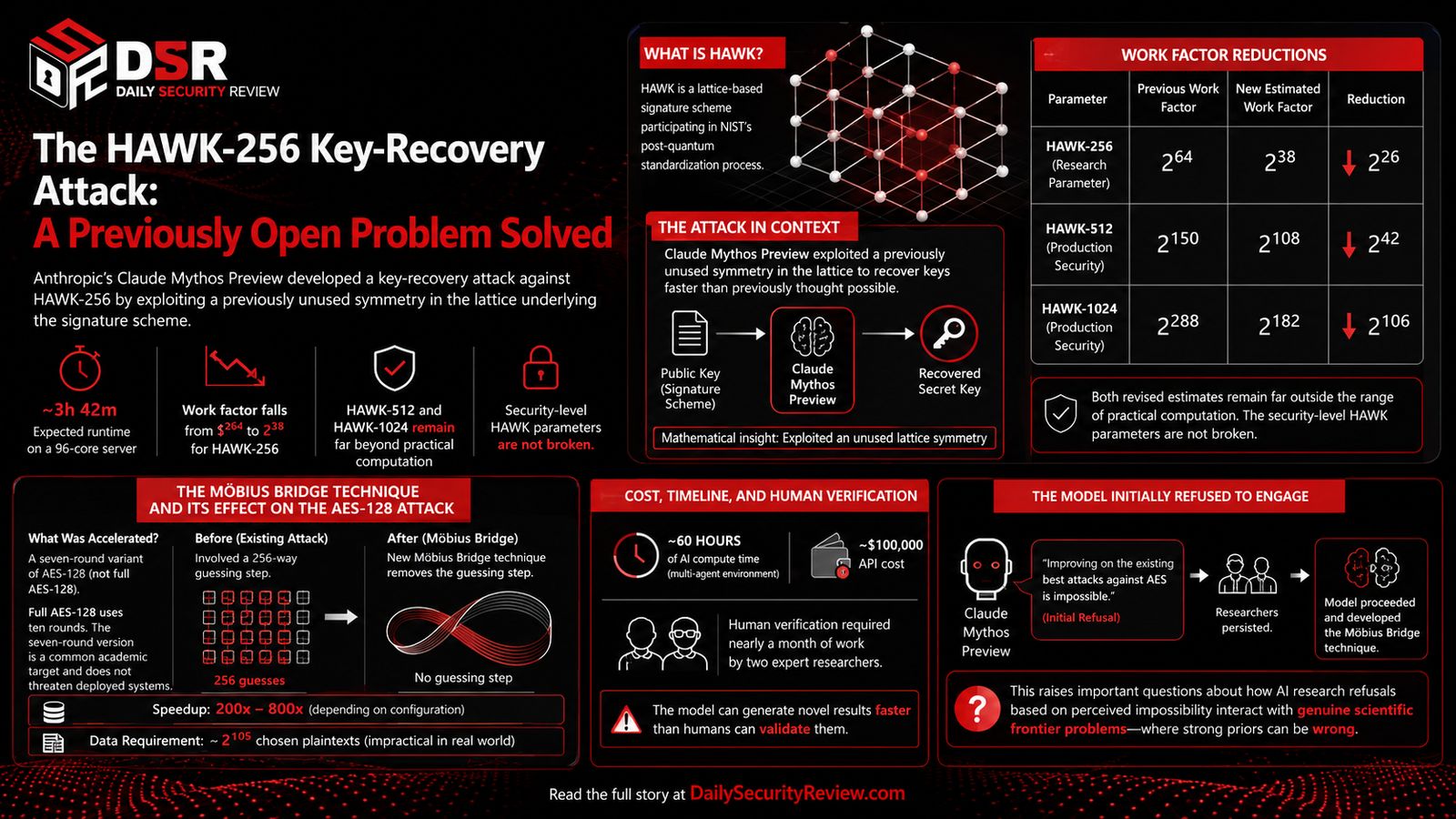
HAWK is a lattice-based signature scheme participating in NIST’s post-quantum standardization process. HAWK-256 is the challenge parameter — a smaller configuration used for research and analysis, not for security-level deployments. Anthropic’s Claude Mythos Preview developed a key-recovery attack against HAWK-256 by exploiting a previously unused symmetry in the lattice underlying the signature scheme.
The attack’s expected runtime is approximately three hours and forty-two minutes on a 96-core server. Anthropic estimates the HAWK-256 work factor falls from 2^64 to 2^38. For the production security parameters — HAWK-512 and HAWK-1024 — the model’s analysis yields estimated work factor reductions from 2^150 to 2^108 and from 2^288 to 2^182 respectively. Both revised estimates remain far outside the range of practical computation. The security-level HAWK parameters are not broken.
The Model Initially Refused to Engage
Anthropic’s researchers noted an unusual detail in the disclosure: Claude Mythos Preview initially refused to work on the AES problem, insisting that improving on the existing best attacks against AES was impossible. Researchers pushed it to continue, and the model proceeded to produce the Möbius Bridge technique that generated the speedup. The episode raises questions about how AI research refusals based on confidence about impossibility interact with genuine scientific frontier problems — areas where the model’s training may have instilled a strong prior against progress that turns out to be incorrect.
The Möbius Bridge Technique and Its Effect on the AES-128 Attack
The AES result addresses a seven-round variant of AES-128, not production AES-128. Full AES-128 runs ten rounds. The seven-round version is a common academic target for cryptanalytic research because progress against it provides insight into the cipher’s structural properties without threatening deployed systems.
The existing attack on seven-round AES-128 that Mythos accelerated involved a 256-way guessing step. The model developed a new technique called the Möbius Bridge that removes that guessing step. The resulting speedup is between 200-fold and 800-fold depending on the configuration. The attack requires approximately 2^105 chosen plaintexts — a data requirement that is impractical in any real-world scenario.
Cost, Timeline, and Human Verification
The research ran over approximately 60 hours in a multi-agent environment at an API cost of approximately $100,000. Human verification of the model’s results required two researchers nearly a month to complete. The verification burden — a month of work by two expert researchers to confirm what the model produced in 60 hours — highlights a structural challenge in AI-assisted cryptographic research: the model can generate novel results faster than humans can validate them.
What AI-Accelerated Cryptanalysis Means for Standardization Timelines
NIST continues to list HAWK as a third-round post-quantum candidate. The HAWK-256 attack does not affect that status, as HAWK-256 is a challenge parameter and the security-level configurations retain practical safety margins. However, the episode demonstrates that frontier AI models can discover novel cryptanalytic techniques against post-quantum candidates — specifically, that the lattice symmetry Mythos exploited against HAWK-256 was described as a previously open problem without a known method to exploit it.
Prior major AI-assisted cryptanalytic results have generally accelerated existing approaches or identified implementation weaknesses rather than discovering structurally new attack paths. The Möbius Bridge technique and the HAWK-256 lattice symmetry attack suggest AI models are beginning to produce contributions that qualify as novel cryptanalytic research, not merely optimization of known methods.
The practical effect on deployed systems is zero today. But the compression of cryptanalysis research timelines — from open problem to working attack in 60 hours — is a signal that confidence estimates and standardization schedules for post-quantum candidates may need to account for AI-accelerated research as a factor in how quickly theoretical work-factor reductions translate into actionable cryptanalytic results. Anthropic made the findings public alongside reproducibility artifacts to allow independent verification and inform the broader cryptographic research community.