Organizations face a growing gap between the security tools they deploy and the confidence they have that those tools are working. Global ransomware attacks reached approximately 7,419 incidents in 2025—a 32% increase year over year—and third-party breaches now account for 30% of all incidents according to Verizon’s 2025 Data Breach Investigations Report. An incomplete picture of your defenses has never been more costly—and a security posture assessment closes that gap. It gives security teams and executives a structured, evidence-based view of where their organization stands: not just which controls exist, but whether they are configured correctly, operating as intended, and aligned to real risk. This guide covers what a security posture assessment involves, how it differs from a pen test or vulnerability scan, and a step-by-step methodology for conducting one.
What Is a Security Posture Assessment and Why Every Organization Needs One
A security posture assessment is a comprehensive evaluation of an organization’s cybersecurity defenses across technology, processes, governance, and people. The goal is to measure how effectively an organization can prevent, detect, and respond to cyber threats—not whether specific tools exist, but whether they are configured correctly, operating as intended, and aligned to real risk.
The term “security posture” refers to the collective strength and readiness of an organization’s defenses at a given point in time. A posture assessment answers the question: how capable are we right now? It examines the full ecosystem—access controls, endpoint configurations, patch management, incident response plans, and employee awareness—and produces a prioritized picture of where the organization is strong, where it is weak, and which gaps carry the most business risk.
Who needs one? Every organization that handles sensitive data, operates critical infrastructure, processes payments, or serves enterprise customers. The need is especially acute for organizations entering regulated markets (healthcare, finance, critical infrastructure), those pursuing SOC 2 or ISO 27001 certification, and those responding to a security questionnaire from a large enterprise customer. According to SecurityScorecard’s 2025 Global Third-Party Breach Report, 35.5% of all breaches originated from third parties—meaning organizations that scored their own controls highly still faced material incidents because gaps in their supplier ecosystem went unmeasured.
How a Security Posture Assessment Differs from a Penetration Test or Vulnerability Scan
These three evaluation types are often conflated but serve different purposes and answer different questions.
A penetration test is adversarial and narrow. Testers attempt to compromise specific systems within a defined scope, producing evidence of exploitability. It does not evaluate governance maturity or whether untested controls would hold up under a real attack.
A vulnerability scan is automated and technical. Scanners identify known weaknesses in systems and applications but do not assess whether those weaknesses are being remediated or how they translate to business risk.
A security posture assessment is broader and evaluates the organizational layer, not just the technical one. It examines whether your patch management process runs reliably, whether your incident response team has tested its playbooks, whether third-party vendors are monitored continuously, and whether access control policies reflect least privilege in practice—not just in documentation. A posture assessment tells you whether your security strategy is sound; a pen test tells you whether specific parts of it can be broken. Both serve important roles in a mature program, but neither replaces the other.
The Core Components of a Cybersecurity Posture Assessment
No two assessments are identical, but a rigorous cybersecurity posture assessment examines five interconnected domains. Together, these domains give security teams a complete picture of exposure, capability, and readiness—and produce the gap list that drives remediation.
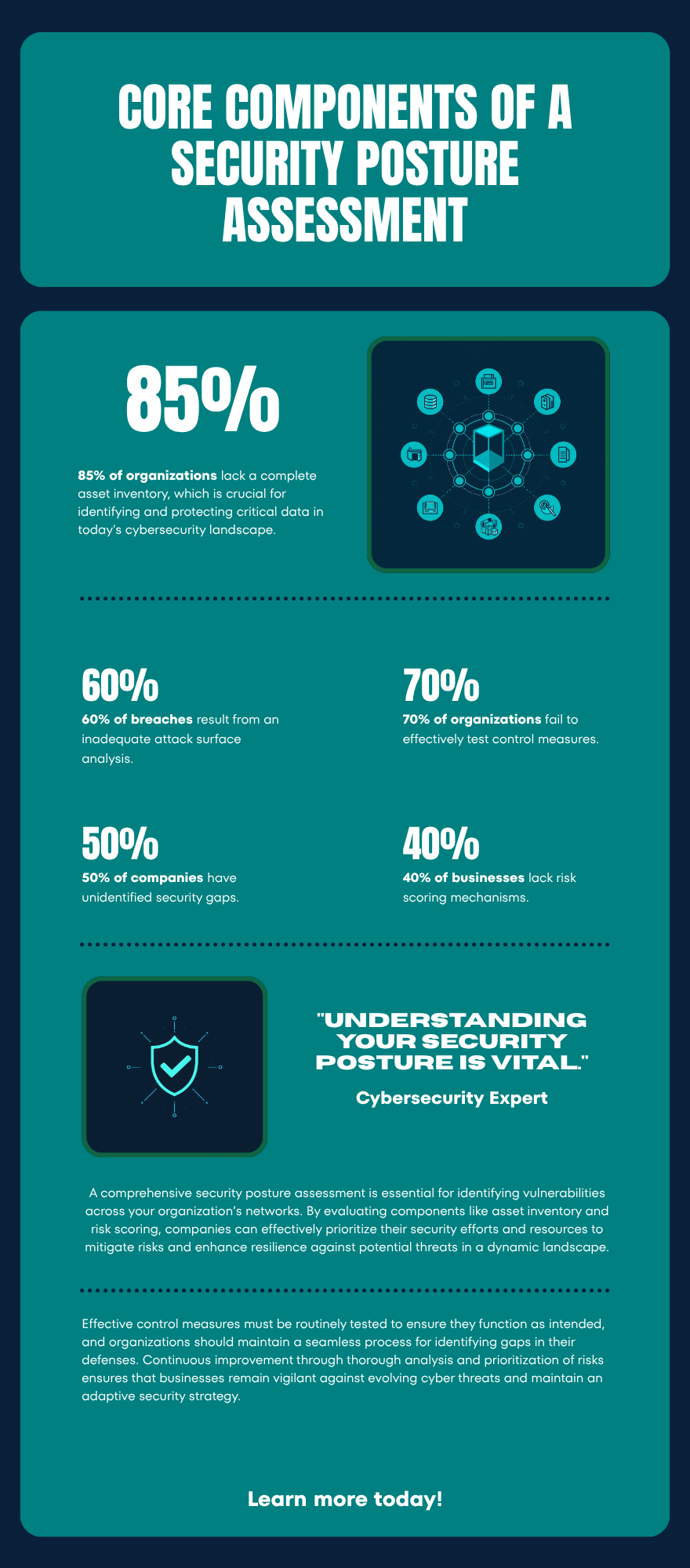
Infographic: The five core components of a security posture assessment. Canva design ID: DAHMFqi0iWs. Publisher: re-export and upload to WordPress before publishing.
Asset Inventory and Attack Surface Mapping
You cannot protect what you cannot see. Asset inventory is the foundation of any posture assessment—and it is consistently where organizations discover the most significant gaps. A complete inventory includes on-premises servers, workstations, laptops, network devices, cloud instances, SaaS applications, data repositories, APIs, and third-party integrations.
Attack surface mapping builds on this inventory. It identifies every asset, interface, and pathway that a threat actor could reach from outside the network perimeter or from within a compromised internal system. This includes external-facing web applications and APIs, remote access portals (VPN, RDP, SSH), cloud storage with misconfigured access controls, and supplier integrations that expose internal systems to third-party environments. The attack surface expands every time a new SaaS tool is adopted, a contractor is granted remote access, or a device connects to the network outside a formal provisioning process. According to Palo Alto Networks’ 2024 State of Cloud Native Security Report, 91% of respondents say fragmented point tools create blind spots that affect threat prevention—meaning most organizations’ attack surfaces are larger than their security teams realize.
Security Control Effectiveness Testing
Confirming that a control exists is not the same as confirming it works. An organization might have endpoint detection and response (EDR) deployed on 95% of its endpoints—but if the 5% missing include servers running critical financial applications, the control’s effective coverage is far lower than its nominal coverage suggests.
Control effectiveness testing evaluates whether deployed controls produce the outcomes they are supposed to produce: whether alerts fire when they should, whether access is denied when policy requires it, whether backup jobs complete successfully and are verified through restoration exercises, and whether logs reach the SIEM and are parsed correctly. This component typically produces the most immediately actionable findings in a posture assessment—gaps between assumed and actual performance are often correctable quickly once identified.
Security Gap Analysis Against Compliance Frameworks
Frameworks like the NIST Cybersecurity Framework (CSF) and ISO/IEC 27001 provide structured baselines for measuring control implementation. A security gap analysis maps current controls against one of these frameworks and records where controls are absent, partially implemented, or implemented but untested.
The output is a structured gap list. A critical distinction: recording a control as “implemented” when it has not been tested or verified is a common error that produces optimistic assessments with little predictive value. An accurate gap analysis acknowledges the difference between control existence, control configuration, and verified control performance. This distinction is what separates a credible posture assessment from a checkbox exercise.
Risk Scoring and Prioritization
A gap list without prioritization is not actionable at the executive level. Risk scoring translates gaps into a ranked list by weighting each finding against two dimensions: the likelihood that a given gap would be exploited, and the business impact if it were. Inputs include asset criticality, presence of known exploits for associated vulnerabilities, time since last patch, regulatory scope of affected data, and the asset’s exposure profile.
A critical vulnerability in an internet-facing payment processing system with a known public exploit ranks fundamentally differently than the same vulnerability in an air-gapped development environment. Risk scoring is the mechanism that communicates this distinction to decision-makers and allows security teams to make a defensible case for prioritization.
How to Conduct a Security Posture Assessment: A Six-Step Methodology
Organizations that treat a posture assessment as a one-time event miss its most important purpose—the value comes from repeated execution, establishing a baseline and measuring progress against it. The following methodology applies whether you run the assessment internally, engage a third-party firm, or evaluate a vendor’s posture as part of third-party risk management.

Infographic: The six-step security posture assessment methodology. Canva design ID: DAHMFsCHRbk. Publisher: re-export and upload to WordPress before publishing.
Step 1: Define Scope and Select a Security Framework
Before inventorying a single asset, establish what the assessment covers and which standard it will be measured against. Scope decisions affect every subsequent step. A narrow scope—one application or a single business unit—produces faster results but misses systemic risk. An enterprise-wide scope captures systemic risk but requires more resources and time.
Choose a framework appropriate to your industry and objectives. The NIST Cybersecurity Framework (CSF 2.0), updated in 2024, is the most widely used reference in the United States across industries and provides a six-function structure: Govern, Identify, Protect, Detect, Respond, and Recover. ISO/IEC 27001 is the dominant international standard and is frequently a contractual requirement in enterprise procurement. CIS Controls v8 provides 18 prioritized control families useful for organizations with limited maturity who need a clear starting point. Maintain the same framework across successive assessments so that progress can be measured against a stable baseline.
Step 2: Build a Complete Asset Inventory and Classify Each Asset
Asset inventory is where many assessments stall—not because the task is technically complex, but because asset records are fragmented across teams and shadow IT is widespread. Automated discovery tools scan network ranges and cloud environments but rarely capture everything. Manual processes are necessary: reviewing vendor contracts, interviewing department heads, auditing identity provider configurations, and checking SaaS subscription platforms.
Classify each asset by criticality and data sensitivity. A server in PCI DSS scope warrants different treatment than a development workstation without production access. This classification directly informs risk scoring in later steps.
Step 3: Perform an Attack Surface Analysis
Map every external-facing entry point: which assets are reachable from the internet, which systems authenticate externally, and which integrations expose internal data to third-party environments. Separate the external attack surface (internet-reachable systems) from the internal attack surface (pathways reachable from within a compromised internal environment).
Threat modeling adds structure. The STRIDE framework (Spoofing, Tampering, Repudiation, Information Disclosure, Denial of Service, Elevation of Privilege) provides a category-by-category lens for how each exposed interface could be attacked. Apply STRIDE to high-criticality and external-facing assets, documenting each exposure point with its threat categories and Step 2 asset classification for use in the gap analysis.
Step 4: Run a Security Gap Analysis Against Your Framework
Map each control domain in your chosen framework to its current implementation status, recording whether each control is absent, partially implemented, or fully implemented—and what evidence supports that classification. A control recorded as “implemented” without supporting documentation or test results is an assertion, not a verified finding.
The gap analysis should distinguish three categories: controls that do not exist, controls that exist but have not been tested, and controls that have been verified to operate as intended. Many organizations find that the middle category—implemented but untested—is larger than expected. That gap between compliance posture and operational security posture is where most assessments generate the highest-value findings.
Step 5: Score and Prioritize Security Risks
Apply a risk scoring model to the gap list. Weight each gap against asset criticality, exploit availability, data sensitivity, and regulatory scope. A 1–5 scale on each dimension, multiplied and normalized, produces a ranked list security teams can defend to executives and use to allocate remediation resources.
Organizations communicating risk in financial terms—for board reporting or cyber insurance—can map scored gaps to probable loss ranges using the FAIR (Factor Analysis of Information Risk) framework, with the risk scores from this step as inputs.
Step 6: Build and Track a Remediation Roadmap
The final deliverable is a prioritized remediation roadmap: a sequenced list of actions organized by risk priority, ownership, and estimated effort. High-severity findings with available fixes appear first; medium-severity findings requiring multi-team coordination come next; structural changes requiring architecture work or vendor renegotiation get longer timelines with named owners.
Track remediation progress against the roadmap and re-assess affected controls once remediation is complete. This step converts a one-time audit into a continuous improvement process. Without explicit tracking, remediation stalls as teams return to daily operations, and the next assessment surfaces the same gaps as the previous one.
Proving Your Security Posture During Vendor and Regulatory Assessments
A growing share of enterprise procurement processes require suppliers to demonstrate their security posture before a contract is signed—and to provide updated evidence on a recurring basis. SecurityScorecard’s 2025 Global Third-Party Breach Report found that organizations with mature third-party risk management programs are 50% less likely to experience material third-party breaches. The security posture assessment is the primary mechanism for generating that maturity evidence.
What enterprise assessors look for varies by industry, but common signals include ISO/IEC 27001 certification or SOC 2 Type II report, completed Shared Assessments SIG or Cloud Security Alliance CAIQ questionnaires, documented continuous monitoring, and a tested incident response plan. Organizations with current asset inventories, up-to-date gap analyses, and documented remediation progress can respond to vendor requests in hours rather than weeks—a capability that is now a commercial differentiator, not just a compliance requirement.
For regulated industries, the stakes are higher. European regulators recorded more than 443 data breach notifications per day in 2025. NIST CSF alignment is increasingly cited by CISA, HHS, and FFIEC as the expected control baseline for U.S. regulated entities. Regulatory bodies are moving away from self-attestation and expect documented evidence of the kind a structured posture assessment produces.
Tools That Support Continuous Security Posture Management
A security posture assessment is most valuable when it feeds into a continuous monitoring program rather than occurring as a standalone event. Several tool categories support ongoing posture visibility.
Cloud Security Posture Management (CSPM) platforms continuously scan cloud environments for misconfigurations, excessive permissions, and policy drift. Leading platforms—including Wiz, Microsoft Defender for Cloud, and Palo Alto Prisma Cloud—map findings to compliance frameworks and provide risk-scored remediation queues. These platforms directly address the fragmentation problem behind the blind-spot risk identified in the 2024 Palo Alto Networks research.
SIEM and security analytics platforms aggregate logs from across the environment and apply detection rules and behavioral analytics to identify threats. Modern SIEM deployments incorporate threat intelligence feeds that correlate internal events against known adversary TTPs from sources like MITRE ATT&CK, giving analysts context about whether observed activity matches known attack patterns.
Vulnerability management platforms such as Tenable Nessus, Rapid7 InsightVM, and Qualys automate recurring vulnerability scanning, track remediation progress, and produce risk-scored dashboards. These platforms provide the continuous vulnerability data that feeds into the risk scoring model from Step 5.
GRC (Governance, Risk, and Compliance) platforms such as OneTrust, ServiceNow GRC, and Archer maintain control libraries, evidence repositories, and framework mapping tables. They make quarterly or continuous gap analysis practical rather than an annual manual exercise, and they generate the documentation trails that vendor assessors and regulatory auditors require.
No single tool provides a complete posture picture. Effective security posture management integrates inputs from cloud, endpoint, network, identity, and third-party sources into a unified risk view—and the six-step methodology in this guide is what gives those outputs meaning.
Conclusion
A security posture assessment is the mechanism that translates security investment into measured confidence. It answers the questions that matter most to security teams and executives: where are defenses strongest, where are they weakest, and which gaps pose the most risk to the business? The six-step methodology covered here—scoping to a framework, building a complete asset inventory, mapping the attack surface, running a gap analysis, scoring risk, and building a remediation roadmap—gives organizations a repeatable process for generating that evidence.
Organizations that do this well treat posture assessment as a continuous discipline rather than an annual checkbox. They integrate assessment outputs into ongoing monitoring programs, vendor evaluations, and board-level risk reporting. That discipline is now a commercial and regulatory expectation, and it begins with an honest measurement of where you stand today.